

Table of Contents
Ever watched a comedy show and thought, "I wish I could do that?" Well, you might be surprised to learn that you can! Forget memorizing lines and rigid scripts, improv is all about thinking on your feet and creating hilarious moments in real-time. An improv class isn't just for aspiring comedians; it's a fantastic way to boost your confidence, sharpen your communication skills, and unleash your creativity. This article is your backstage pass to the world of improv, and we're going to explore what really happens in an improv class. You will discover why stepping into this world is a good idea and how you can find the perfect class for you. Get ready to say "yes, and..." to a whole new adventure!
What Happens in an Improv Class?

What Happens in an Improv Class?
The Warm-Up Games
Okay, so you walk into an improv class, maybe a little nervous, maybe super excited. First things first: the warm-up. Forget boring stretches; we're talking silly, energetic games designed to get you out of your head and into the moment. Think name games where you have to remember everyone’s name in a circle, or maybe a “zip-zap-zop” game where you pass energy around the room. It’s like recess for grown-ups, and it's all about breaking the ice, getting comfortable with your classmates, and letting go of any inhibitions.
These warm-ups aren't just random fun; they are sneaky exercises in focus and collaboration. You're learning to listen actively, react quickly, and support your fellow improvisers. It's like a team sport, except the only competition is against your own self-consciousness. You'll find that the sillier the game, the faster you lose the fear of looking silly, which is a key ingredient in improv.
Improv Fundamentals
After the warm-up, the class often transitions into the meat of improv: the fundamentals. This is where you learn the basic rules of engagement, if you can call them rules. The most important one? "Yes, and..." This means accepting whatever your scene partner offers and building upon it, rather than shutting it down with a "no" or a block. It's like a conversation where you're always agreeing and adding to the story.
You’ll also practice creating characters, exploring different emotions, and building scenes with no script. There are exercises focused on "object work" where you create imaginary objects or places, or others where you practice storytelling. The goal is to learn how to create characters and stories together, relying on each other's creativity and imagination. It's a bit like a group of friends playing pretend, except now you're actually learning valuable skills.
Improv Element | Description | Example |
|---|---|---|
"Yes, and..." | Accepting and building on offers | "I see a giant purple elephant!" "Yes, and it's wearing a tiny hat!" |
Character Work | Creating distinct characters | A grumpy librarian or a hyperactive puppy |
Object Work | Creating imaginary objects | Pretending to hold a hot potato |
Why You Should Try an Improv Class
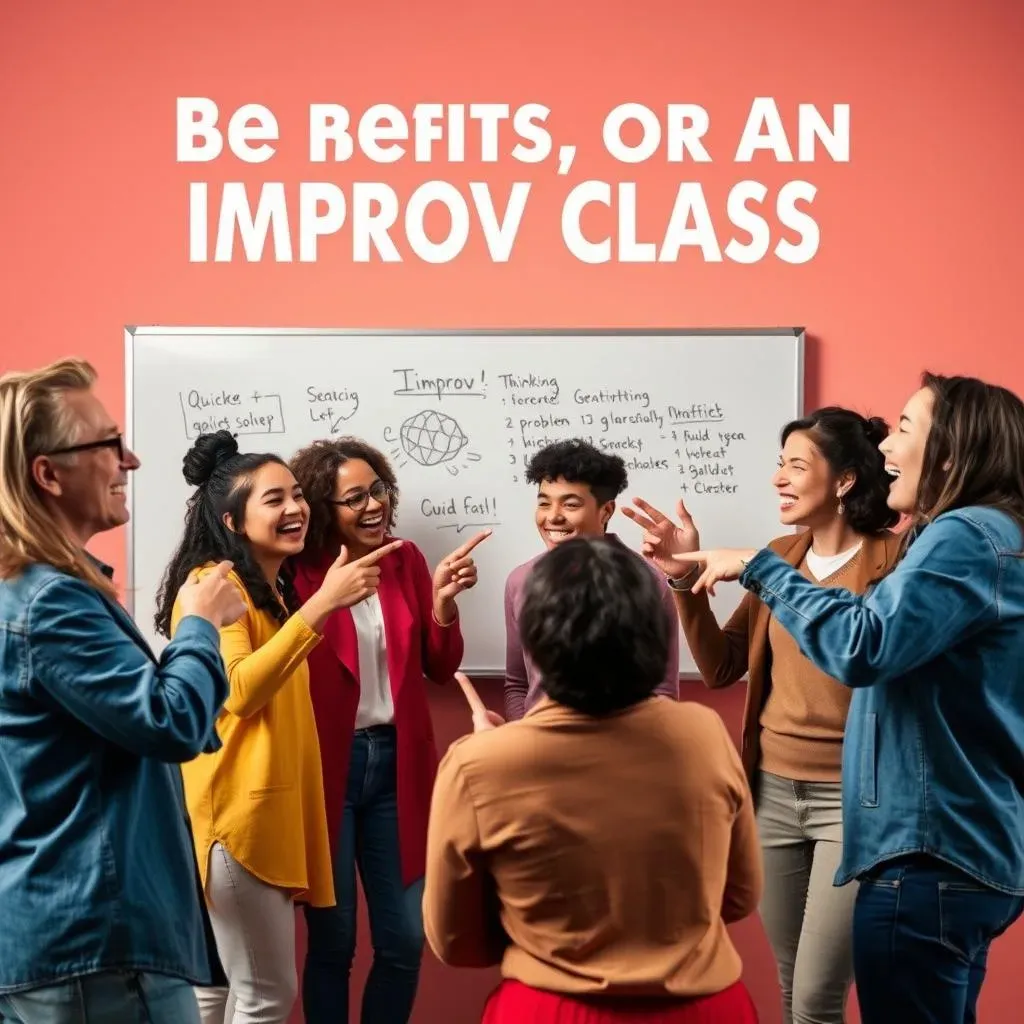
Why You Should Try an Improv Class
More Than Just Laughs
Okay, so you might think an improv class is just about being funny, but it's so much more than that. Sure, you'll laugh—a lot—but the benefits extend far beyond comedy. Think of it as a workout for your brain. You're constantly thinking on your feet, reacting to unexpected scenarios, and collaborating with others. It's a fantastic way to improve your quick thinking and your ability to adapt to changes. It’s like a mental gym where you’re lifting the weights of new ideas and funny situations, all while having a blast. You might walk in thinking you're just going to be silly, but you'll leave with a sharper, more agile mind.
Also, let's be honest, who couldn't use a little boost in their confidence? Stepping onto a stage, even a small one in a class, can be daunting. But with each scene you create, each character you embody, you'll feel yourself growing more comfortable with taking risks and expressing yourself. It's like building a muscle, but for your inner courage. You learn to trust your instincts, embrace imperfection, and connect with others in a more authentic way. The skills you pick up in an improv class will make you more confident not just on stage, but in everyday life too.
Real-Life Superpowers
The skills you learn in an improv class aren't just for the theater; they’re like real-life superpowers. Improved communication is a key benefit. You'll learn to listen actively, respond thoughtfully, and articulate your thoughts more clearly. This comes in handy in every aspect of your life, from work meetings to family dinners. You'll be able to understand people better and express your own ideas more effectively. It's like upgrading your conversational skills from dial-up to fiber optics.
Furthermore, improv class teaches you how to be present and adaptable. Life throws curveballs, and improv helps you learn to roll with the punches. You become more comfortable with uncertainty and better at finding creative solutions to unexpected problems. It’s like learning to dance with the unexpected, instead of tripping over it. You'll find yourself less stressed, more resourceful, and better equipped to tackle whatever life throws your way. And who wouldn't want a little more of that?
Benefit | Description | Real-Life Application |
|---|---|---|
Quick Thinking | Reacting fast in scenes | Problem-solving at work |
Confidence | Taking risks on stage | Public speaking and presentations |
Communication | Listening and responding | Better relationships and teamwork |
Adaptability | Handling unexpected situations | Coping with change and stress |
Finding the Right Improv Class for You

Finding the Right Improv Class for You
Consider Your Comfort Level
Alright, so you're pumped about trying an improv class, but where do you even start? It's like choosing a flavor of ice cream – there are so many options! First, think about your comfort zone. Are you someone who loves to jump right into the deep end, or do you prefer to dip your toes in slowly? Some classes are designed for total beginners, with a focus on the fundamentals and creating a supportive environment. Others might be more advanced, assuming you have some experience. Don't feel pressured to pick the most challenging class if you're not ready. It’s all about finding a place where you can feel comfortable enough to let your guard down and have fun.
Also, consider the size of the class. A smaller group can feel more intimate and allow for more individual attention, while a larger class might offer more energy and variety. Think of it as choosing a party – do you want a small gathering with close friends, or a big bash with lots of people? Both have their own unique vibe, so pick the one that sounds like a better fit for you. Don't be afraid to do a little research, read reviews, and maybe even contact the school or teacher beforehand to get a better sense of the class. It's like trying on a new pair of shoes – you want to make sure they fit well before you commit to wearing them all day.
Class Style and Focus
Next, think about the style and focus of the improv class. Some classes might focus on short-form games, like the ones you see on shows like "Whose Line Is It Anyway?", while others might lean towards long-form improv, where you create longer scenes and stories. Some might even incorporate elements of sketch comedy or musical improv. It’s like choosing a genre of movie – do you want action, comedy, or drama? Each style offers a different experience, so think about what excites you most.
Also, consider what the class emphasizes. Is it about character development, storytelling, or just plain silliness? Some classes might be more focused on performance and stage presence, while others might be more about personal growth and collaboration. It's like choosing a sport – do you want to focus on technique, teamwork, or just having a good time? Think about your goals and what you hope to get out of the class. It’s helpful to find a class that aligns with your interests and what you want to learn. It’s a lot like picking a new hobby – you want to choose something that you're excited about and that fits your style.
Class Feature | Description | Consider If You |
|---|---|---|
Beginner-Friendly | Focus on fundamentals | Are new to improv |
Small Class Size | More individual attention | Want a more intimate setting |
Short-Form Games | Fast-paced, quick scenes | Enjoy high-energy and silliness |
Long-Form Improv | Longer, developed stories | Like creating narratives |
Performance Focus | Emphasis on stage presence | Want to improve performance skills |
Try Before You Commit
Finally, don't be afraid to try a class or two before fully committing. Many places offer introductory classes or workshops that are a great way to get a feel for the teacher, the style, and the overall vibe. It's like test-driving a car – you want to see how it handles before you sign on the dotted line. Don't be shy about asking questions, observing a class, or even talking to current students. You want to make sure the class is a good fit for you.
Remember, finding the right improv class is about finding a place where you feel comfortable, supported, and excited to learn. It's not about being perfect or being the funniest person in the room; it's about being open to new experiences, stepping outside your comfort zone, and having fun. It's a journey, not a destination. So, take your time, explore your options, and get ready to say "yes, and..." to a whole new world of laughter and self-discovery. It is a lot like choosing a new adventure – you want to make sure it’s the right one for you!